.png?width=337&height=96&name=Logo%20(1).png)

Research integrity and peer review have always been linked. Peer review is the mechanism the system built to protect scientific credibility — and for decades, when it worked, it worked because the threats it faced were manuscript-level threats.
That is no longer true.
The threats growing fastest right now are not problems a reviewer can catch in a manuscript. They operate in authorship networks, in citation databases, in the training data of AI systems, and in the coordinated submission patterns of paper mills running across dozens of journals at once. A reviewer evaluating a single paper has no line of sight into any of this.
This is not an argument against peer review. It is an argument for being clear about what peer review can and cannot see — and for building the defences that sit before it.
What Peer Review Was Built to Do
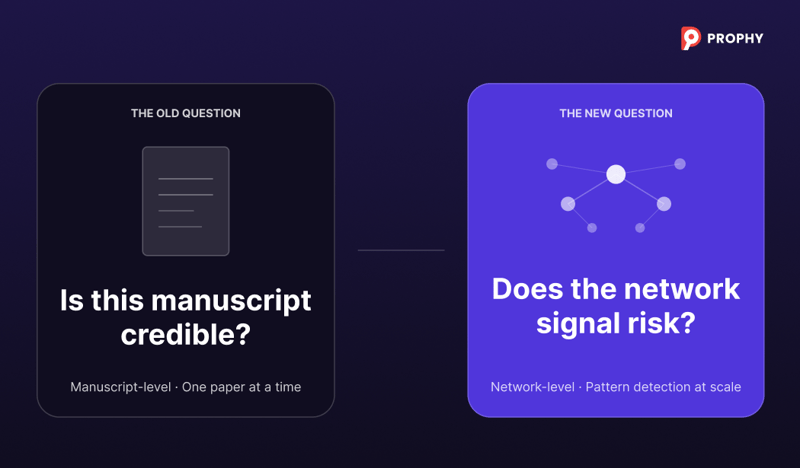
Peer review's job is to evaluate whether a submitted manuscript makes a credible, original contribution to its field. A reviewer with genuine expertise can assess methodology, interrogate assumptions, and flag results that don't hold up.
What it was not designed to do: catch fake authors. Detect citation farms. Identify a manuscript generated by AI and submitted by a paper mill operating simultaneously across dozens of journals. Screen for co-authorship patterns that indicate organised fraud. Flag infrastructure-level manipulation of the citation data the review process itself depends on.
These are research integrity problems. But they are network-level, system-level, and structural — and peer review has no mechanism to reach them.
The Threats That Arrive Before the Reviewer Sees the Paper
Four leading voices in scholarly publishing gathered in February 2026 to answer one question: what research integrity threats are coming in the next two to five years?
None of them named a problem that peer review, as currently practiced, could reliably catch.
Jason Hu, Director of Research Integrity at Taylor & Francis, framed it this way: the industry is shifting from fake papers to a fake knowledge system. Individual fraudulent articles are a peer review problem. A contaminated scientific literature — where AI-generated content, papermill output, and uncorrected retracted papers form the training data for the next generation of AI tools — is not.
He raised a second concern that cuts to the publishing business model: readers are increasingly turning to AI-generated summaries rather than original sources. That erodes both the reach of reliable knowledge and the value journals provide. A reviewer approving or rejecting one manuscript cannot see this, because it is happening at the level of the whole system.
Graham Kendall, Vice Chancellor of MILA University and a researcher with over 300 publications, identified the mechanism behind this: AI-generated papers, once published, train the LLMs that generate the next wave of AI content.
"In two to five years, when you ask an LLM a question, it's going to draw on stuff that it wrote two years ago, which is nonsense anyway," he said. "AI is writing papers which are nonsense, and then LLMs are learning from those papers."
He also flagged citation mills — coordinated networks generating circular self-citations to inflate researcher metrics. In one case he described, a researcher published 124 papers in a single year, mostly self-citations, building an H-index of 24 in the process. The reviewer who evaluated any one of those papers had no way of knowing the pattern existed.
Jayne Marks, CEO of Maverick Publishing Consultants, who has spent her career in publishing roles across Nature Publishing Group, Sage, and Wolters Kluwer, named a threat that lives entirely outside any manuscript: a targeted attack on core publishing infrastructure.
"What happens if paper mill companies hack into some of our core infrastructure?" she said, naming Crossref specifically — the backbone of DOI registration and metadata across scholarly publishing. If bad actors manipulated citations or author names at that level, the damage would be hard to contain and harder to detect. Peer review has no mechanism for this. It doesn't sit in the right part of the process.
Sukhwant Singh, COO of Newgen KnowledgeWorks, named the quietest threat of all: credibility dilution.
"There may be many papers that are not fake science, not misconduct. But because of the sheer volume, there's a credibility dilution — it becomes harder for editors, reviewers, and readers to assess the reliability and robustness of the research."
A reviewer can only evaluate the paper in front of them. They cannot compensate for a signal-to-noise ratio degrading across the entire literature. And as submission volumes keep growing, the average attention available per paper must fall.
For a full account of each panelist's predictions, see the Prophy Predicts webinar recap.
The Disclosure Problem Inside the Process
There is a second issue sitting inside peer review rather than outside it — and the industry is still reluctant to discuss it directly.
Peer review's integrity depends on honest disclosure. Authors are expected to declare conflicts of interest, acknowledge AI use, and provide accurate author contributions. Reviewers are expected to disclose conflicts and not use AI to write their assessments without disclosure.
The evidence suggests these norms are not holding.
Graham Kendall was direct: "In the next two to five years, a significant number of articles published will have been written by AI and reviewed by AI — with limited, if any, human input. And we may not know which articles fall into this category."
Jason Hu named undisclosed AI use in peer review as a growing problem that "erodes the trust between reviewers, editors, and authors, but also erodes the creativity of human beings."
When peer review depends on self-disclosure, and that norm is breaking down, it cannot be the primary mechanism for protecting research integrity. The system is only as strong as the information flowing into it.
Where the Defence Needs to Sit Instead
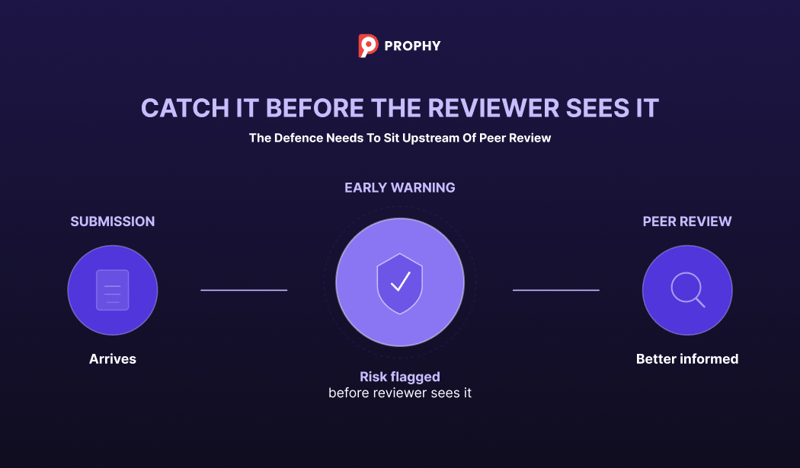
All four panelists pointed in the same direction: earlier in the workflow, using tools that analyse patterns rather than evaluate individual manuscripts.
Sukhwant Singh was most explicit: "The shift needs to move from detecting bad actors at the point of publication to a point where it is being submitted, or even before that. We need mechanisms that strengthen the research earlier in the workflow."
In practice, that means authorship and citation network analysis running at submission — checking whether the author list shows patterns consistent with ghost authorship, paper mill rings, or fraud clusters. None of this is visible in the manuscript itself. But it is visible in the network of relationships across the literature.
It means behavioral pattern detection across submission batches — flagging when a group of manuscripts shows structural similarities suggesting common origin, or when submission timing from a source diverges from normal patterns.
This is the logic behind Prophy's Early Warning System. It runs pattern-based risk detection — authorship and citation network analysis — across 189 million articles and 94 million researcher profiles, flagging high-risk submissions before they reach peer review.
For a broader look at how evaluation systems can protect research integrity — including conflict detection, reviewer diversity, and purpose-built AI — see our article on how modern peer review protects research integrity.
The Incentive Problem Underneath All of This
There is a structural issue that no single tool or workflow change can fix alone.
The current evaluation system — impact factors, citation counts, publication volume — creates the incentives that fuel the threats above. Paper mills exist because there is a market of researchers willing to pay for authorships because publication metrics determine career outcomes. Citation farms exist because H-indices drive funding decisions.
Jayne Marks: "We've got all these perverse incentives. The incentives from funders to institutions, from institutions to researchers, from researchers to publishers — none of it works together."
Graham Kendall raised the enforcement gap. Unlike law, medicine, or architecture, academic publishing has no body with real disciplinary power. He cited a publisher fined $50.1 million for unethical practices. They never paid. They are still operating.
Jason Hu called for collaboration across the full stakeholder chain — treating research integrity as shared infrastructure, not each party's separate problem. The United2Act initiative is one example of that coordination forming, though not yet at sufficient scale.
What This Means for Editorial Teams Right Now
Peer review evaluates manuscripts. The fastest-growing threats are not manuscript problems — they are authorship problems, citation problems, and system-level contamination problems. Catching them requires looking at the network, not just the document.
For Editors-in-Chief, Heads of Peer Review, and Publishing Directors: if your current integrity workflow begins when a paper enters peer review, it begins too late.
The publishers who come out ahead will be the ones who move that line. Not to replace reviewer judgment, but to give it better information to work with.
Prophy's Early Warning System detects high-risk submissions before peer review, using pattern analysis across 189M+ articles and 94M+ researcher profiles. Request a demo at prophy.ai.